
Hyenas Among the Coffee Trees in Harar, Ethiopia
A wildlife biologist follows Harar’s wild hyenas from city streets into Ethiopia’s coffee farms—and discovers an unlikely coexistence shaped by culture and place.
Author’s note: The names of some private individuals have been changed to protect their privacy.
“Rest assured. These predators are safe.”
At least, that is what the people of Harar, Ethiopia, told me about the spotted hyenas that wandered the city after dark.
Harar’s hyenas are neither pets nor harmless animals. They remain formidable wild predators, yet generations of close contact have made them familiar presences, respected by many residents and woven into the city’s spiritual life.
I had come to Harar hoping to experience both its coffee culture and its hyenas. I had no reason to imagine they belonged to the same story.
I arrived in early November 2025, at the beginning of what would become a month-long journey tracing coffee back to its origins. At first glance, Harar seems like an odd place to begin a story about coffee. It is dry and acacia-dotted, a world apart from the lush rainforests where wild Arabica naturally grows. And yet Harar became one of the most important coffee-trading cities in the Horn of Africa. Southwestern Ethiopia may have been Arabica’s botanical birthplace, but the eastern city of Harar became one of the gateways through which coffee moved toward the wider world.
When I first arrived, however, I didn’t know any of this.
What I did know was that Harar was renowned for its elaborate coffee ceremonies and was home to enough roaming hyenas to make any itinerary a little more interesting.
Before coming, I had found it surprisingly difficult to arrange a visit to one of the coffee farms in the surrounding hills. There was nothing online to book and no farm tours readily advertised. As Ethiopia would repeatedly remind me throughout my travels, sometimes the only way to experience a place was to show up and figure it out.
To keep things within walking distance, my travel companion and I stayed inside Harar’s old walled city rather than in the newer neighborhoods beyond it. After dropping our bags, we stepped onto the balcony of our Airbnb, which overlooked a maze of rooftops and narrow alleyways. Beyond the maze of rooftops, the old stone wall traced a tight boundary around Harar Jugol. It stood roughly 10 to 13 feet tall and ran for just over two miles. Black kites perched atop power lines while uniformed children walking home from school spotted us immediately.
“Farenjo! Farenjo!” they shouted, laughing and waving enthusiastically.
Farenjo was Harar’s local variation of the Ethiopian word farenji, referring to a foreigner—especially a white foreigner. To some, it might sound like an insult, but I found it endearingly amusing.
Why yes, small child. I am rather odd-looking, I thought, waving back.
That evening, while searching for dinner, we started asking whether anyone knew how to reach a local farm. Before long, several men introduced themselves as guides, each eager to show us Harar for a fee, but none knew much about coffee beyond what was sold in the market.
Then we met Solomon.
Unlike the others, he never tried to sell us anything. Instead, he recommended a restaurant and struck up a conversation as though we had been friends for years. We invited him to join us for dinner, and he happily accepted, helping us decipher the menu before recommending fetira, a simple, flat wheat-and-egg dish resembling a plain omelet pizza.
As we ate, I explained why I had come halfway around the world.
Solomon considered my words for a moment.
“You’re the first farenjo I’ve met who wants to see the coffee,” he finally said. “Everyone else comes here for the hyenas.”
My friend smiled.
“Well, we definitely want to see those too.”
“But we’ve already scheduled that for tomorrow night,” I added.
Solomon nodded thoughtfully before reaching into the woven shoulder bag slung across his chest. From it, he pulled a weathered notebook and slid it across the table with a pencil.
“I want to help you,” he said. “Write your names and WhatsApp numbers. It helps me remember people.”
I glanced at my friend.
Had we actually found the right person that easily?
Then Solomon asked something completely unexpected.
“Do you know the man David Attenborough?”
“David Attenborough?” I said. “Yeah, actually. I practically grew up watching him.”
“I was the guide for his show Planet Earth II when they filmed the hyenas in Harar,” he said. “I met him.”
I stared at him.
“Seriously?”
He nodded.
I tried to summon the Harar sequence from memory. I vaguely remembered seeing someone who looked like Solomon in the episode, but I couldn’t be certain.
Had almost anyone else made such a claim, I probably wouldn’t have believed them. Whether every detail was true, I had no way of knowing.
Somehow, I believed Solomon.
Over the next few days, Solomon sent occasional WhatsApp messages saying he was still trying to arrange a visit to a family coffee farm in the village of Koromi. While we waited, we explored like ordinary travelers. We wandered Harar’s winding alleyways, shopped, and sampled local dishes, including goat and camel meat.
At the sprawling Babile camel market, roughly twenty miles east of Harar, hundreds of camels bearing blue spray-painted markings bellowed into the morning air as their hooves kicked up clouds of dust. Handlers whipped the animals and made them kneel while buyers inspected their teeth and bodies for signs of health.
Beyond the market sprawled settlements occupied by people internally displaced by conflict along the Oromia-Somali border. Many had lived there since the violence of 2016 and 2017. By the time I visited, the displacement had lasted nearly a decade, and temporary shelters had taken on the appearance of permanent homes.[1]
The Coffee Ceremony
We also attended a traditional Ethiopian coffee ceremony inside a local home. The house consisted of one large room with raised, carpeted terraces along the edges. Colorful basketry plates covered the walls. We were told that certain sets represented marriages within the family and that an abundant display signaled both the women’s skill and the household’s prosperity. This house had many.
A young woman named Sanja slipped through a curtain carrying a small charcoal stove, a shallow pan, and a bowl of unroasted green coffee beans. Without speaking, she set everything down in front of us and crouched low to the ground. The charcoal crackled softly as she coaxed it to life, feeding the embers until a steady heat shimmered upward.
Then the ceremony began.
She poured the raw beans into the pan and held it just above the coals, moving it in slow, practiced circles.
When the first cracks sounded in sharp, quiet pops, she lifted the pan and carried it deliberately in front of each of us, fanning the smoke toward our faces with her hand. Inhaling the coffee as it transformed was part of the ritual.
The aroma rose around us, heady and intoxicating.
Once the beans reached a deep, even roast, she removed them from the heat and poured them into a wooden mortar. Using a pestle, she pounded them into grounds, then transferred the grounds into a jebena, a rounded clay coffee pot with a long neck. She added water and returned the pot to the charcoal. As it heated, another woman brought in bowls of popcorn.
When the coffee was ready, she poured it carefully into small, handleless cups arranged on a tray, the dark liquid streaming in a thin arc from the narrow spout.
We were served three successive rounds, each tasting slightly lighter than the last. Across Ethiopia, these rounds are commonly known—with regional variations in spelling and pronunciation—as abol or awel, tona, and baraka. The first is generally the strongest; the final round, whose name means “blessing,” completes the ceremony.
As we sat on the carpet with our coffee and popcorn, talking with one another and listening to the conversations around us, I realized that the afternoon—and perhaps my journey through Ethiopia—wasn’t really about coffee’s flavor profile. It was about experiencing how coffee had shaped a culture, how it brought people together, and how a drink could become an expression of community.
By the time the ceremony ended, daylight had begun to fade. We made our way back through the city’s maze to our Airbnb, where we rested and prepared to meet the animals for which Harar was famous.
The Hyena Feeding
At eight that evening, we grabbed our headlamps and cameras, flagged down a tuk-tuk, and rode to the northern hyena-feeding site, about half a mile beyond the city wall. A large, brightly lit visitor center—completed within the past year—stood near the entrance.
Inside, a guard collected a fifty-dollar entrance fee. After paying, we followed the path outside.
As we approached, we heard distant whistling, followed by low grunts, eerie whoops, and the unmistakable cackling laughter of spotted hyenas. The sounds led us into a shallow amphitheater, where a man sat on a stump beside a wicker basket.
Under a bright floodlight, Abbas Yusuf, known locally as the Hyena Man, leaned over the basket and pulled out strips of raw meat. A small audience watched as he placed a piece of meat on the end of a volunteer’s stick. At his whistle, a hyena emerged from the darkness, padded confidently toward the volunteer, and—with astonishing precision—plucked the morsel away in a single bite.
My friend and I could hardly contain our excitement.
Dozens of hyenas occupied the amphitheater. Some lay sleeping in the grass or napped unperturbed on the cool concrete, while others drifted silently among the surrounding trees. A handful lingered close to Yusuf, pacing patiently as though they understood exactly how the evening’s routine worked.
My friend volunteered first.
When my turn came, Yusuf handed me a short stick and motioned for me to hold one end between my teeth. He balanced a strip of meat near the opposite tip before letting out another sharp whistle.
A hyena emerged from behind Yusuf, its shoulders hunched.
It moved toward me without hesitation.
In one swift motion, gleaming jaws opened scarcely a foot from my face before closing around the meat.
I refrained from flinching.
The hyena moved back a few feet, stopped, and licked its ivory canines. Light glinted from the sharp teeth as it ran its tongue over them. Then Yusuf placed more meat on my stick and whistled once more. And the hyena returned time and time again. The meat stank horribly, but I sat there as a statue, someone to hold the food, not The Food.
When the feeding ended, we lingered in the amphitheater, watching the hyenas interact. By 10 p.m., all the other tourists had left, and Yusuf threw his remaining scraps and bones onto the dirt.
By my rough count, more than fifty hyenas converged on the scraps. They growled and snarled as they fought over the feast, scrambling hardest for the bones. Then came the sound of bone breaking between their jaws: crack after crack, crunch after crunch. The noise echoed through the amphitheater beneath their cackling laughter. Dirt flew from their paws as they fought for position. Within minutes, it was over.
Hear the night after the crowd left →
Listen to the original field recording of Harar's hyenas.
We thanked Yusuf and departed grinning from ear to ear.
We walked back in the dark because the last tuk-tuk driver wanted us to pay triple the usual fare. Several hyenas moved in the distance around us. We hoped they’d been fed enough not to bother us. Dogs began barking across the landscape as they tried to ward off the hyenas. Instead of going through the main gate, we detoured to follow a hyena entering the city through a hole in the outer wall. We had to crouch to pass through it. But as we did, the hyena ran ahead, rounded a corner, and quickly disappeared from sight.
Back at the Airbnb, a WhatsApp message from Solomon was waiting: he had arranged our coffee-farm visit for the following morning.
The Coffee Farm Visit in Koromi
Just as promised, Solomon met us outside the eastern gate, overlooking the Hararghe Highlands. Warm orange light bathed the countryside as we walked to our tuk-tuk meeting spot. We found some shade and waited for a long while. Solomon chewed khat, its leaves flecking his teeth green, and carried an entire armful wrapped in plastic.
“A gift for the family,” he explained.
Khat had become impossible to ignore during my time in Harar. The stimulant leaf was woven into everyday life. Over recent decades, farmers across eastern Ethiopia had increasingly replaced coffee with khat or grown the two together. Khat’s frequent harvests and dependable market offered farmers a faster source of income, reshaping livelihoods and land use across the region.[2]
When our tuk-tuk arrived, Solomon, my friend, and I squeezed into the back while several other passengers clung to the front wherever space remained.
Rides into the highlands were too valuable to waste.
The little tuk-tuk rattled violently as it climbed the rough mountain road.
“African massage,” Solomon said, laughing after another jarring rut.
The farther we climbed, the wider my eyes grew as I searched for any sign of a coffee tree. At first, I saw mostly sorghum fields, which gave way to terraces carved into the hillsides. Entire slopes shimmered with khat plantations, while scattered acacia trees cast islands of shade across the sparsely vegetated pastures. Stone homes appeared one by one until, almost imperceptibly, the farmland became a village.
“Koromi,” I said softly.
“Yes, we are here,” Solomon said.
We stopped beside a modest stone house where an entire family emerged to greet us. Children peeked shyly from behind their parents, dressed in white cotton garments, while chickens wandered between their feet.
There wasn’t much time for introductions. The afternoon light was already beginning to fade, and Kiam, the eldest son, motioned for us to follow him.
We slipped through the trees behind the house, and suddenly the farm unfolded beneath us.
It was nothing like the coffee plantations I had imagined.
But there they finally were. Coffee shrubs grew beneath towering native trees alongside sorghum, maize, papaya, banana plants, climbing vines, and plants I couldn’t identify. Brightly colored birds flitted through the canopy, and insects buzzed as we followed Kiam along the irrigation channels.
It felt less like a conventional farm than a living ecosystem. This was multistory agroforestry: coffee and food crops growing beneath and among larger trees.
Kiam stopped in front of a branch, plucked several glossy coffee cherries, and handed them to us before leading us deeper into the property. As Solomon translated his explanations, I found myself paying as much attention to the ecology as to the coffee itself.
“The harvest won’t be for another month,” he said.
Before coming to Ethiopia, I thought I had timed my visit for harvest season. But at Kiam’s farm, most of the cherries were still green. Here, the harvest would begin closer to December.
As we walked, I became curious about the absence of livestock.
“Can you ask Kiam why there are no goats or cows?”
Solomon relayed my question. Kiam answered without hesitation, gesturing as he spoke. Although I couldn’t understand his words, I knew what he meant.
Hyenas.
I turned toward Solomon.
“Is he saying hyenas come onto the farm?”
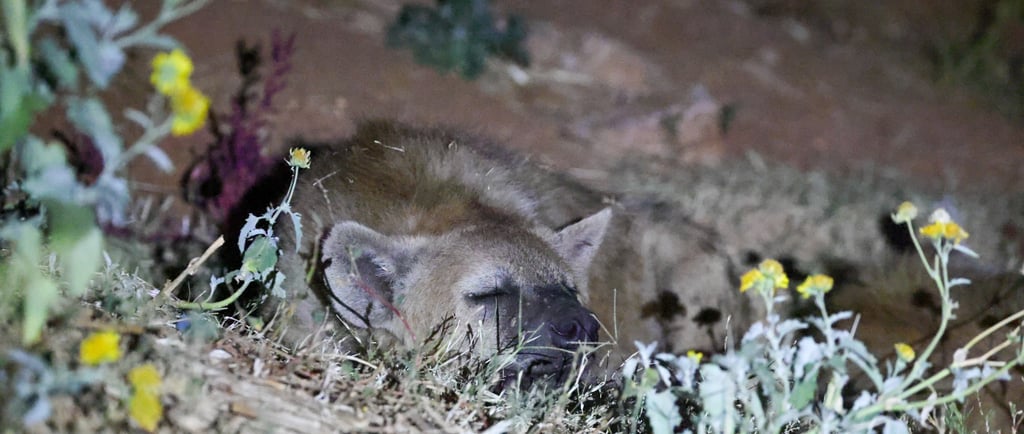
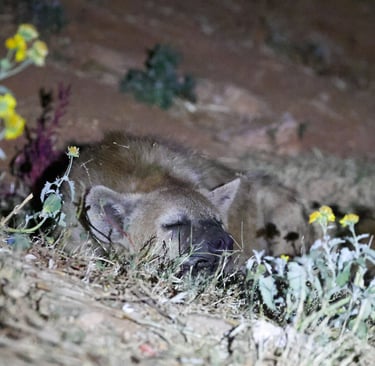
“Oh yes,” Solomon translated. “Kiam says after hunting all night, they come here in the morning and sleep among the coffee trees.”
I stopped and stared.
“That is amazing,” I said.
It made sense now, but I simply hadn’t thought about it that way.
Hyenas weren’t just city scavengers that occasionally wandered into farmland.
The farms were part of their home range.
They hunted these hills beneath the cover of darkness, slept beneath coffee trees during the day, and each evening some drifted toward Harar, where generations of people had quietly learned to live alongside them.
My mind immediately began racing.
I wanted a photograph.
I wanted evidence of a hyena beside a tree full of bright red cherries.
But there was no chance of that today. I had arrived with neither camping gear nor enough time to spend the night in the highlands waiting for the hyenas to emerge.
I had to be satisfied with knowing this for now.
But next time, I promised myself. Next time.
As evening settled over Koromi, we returned to the family’s home. Shoes came off at the doorway, and we washed our hands over a plastic basin before gathering around a single silver platter piled with injera and stewed beans.
Conversation flowed mostly through Solomon while the older men shared fresh khat and laughed among themselves. Every so often, one of the men offered us a gursha, placing a bite of food directly into our mouths as a gesture of hospitality. I noticed the dirt on their hands and felt a flicker of hesitation, but I accepted each bite rather than refuse their hospitality.
Before we left, Kiam’s family brought out a woven tray covered with dried coffee cherries. Brown and wrinkled, the dried fruit still held the beans inside. Solomon said they came from the previous year’s crop.
“These are better,” he said. “Harar coffee is like wine. Age makes it better.”
“This is your coffee,” Solomon translated. “It isn’t ready yet. Tomorrow they will prepare it and send it.”
I paid the family roughly 1,800 birr for the coffee, which was about twelve dollars at the time. I added a little more in thanks for their hospitality.
I received the finished coffee the following day.
Before climbing back into the tuk-tuk, Solomon led us to a nearby shrine dedicated to Abd al-Qadir al-Jilani, a twelfth-century Sufi sheikh who died in Baghdad but became revered far beyond it. Around Harar, shrines like this are places of prayer and pilgrimage, but also of stories about saints and the invisible world. Some shrines outside the city walls even prepare porridge for hyenas during Ashura, binding the animals to Harar’s spiritual life.[3]
As we crunched through dry leaves, Solomon told us about the spirits said to be associated with the place. The air was eerily still, and the evening light was fading.
When we emerged from the shrine, the silence gave way to children running toward us from seemingly every direction.
“Farenjo!” they shouted familiarly.
They reached for our hands, tugged curiously at our sleeves, giggled at our unfamiliar clothes, and followed us all the way back to the waiting tuk-tuk.
As we pulled away, they ran after us, waving frantically.
We waved until the village disappeared behind the hills.
Night overtook us halfway down the mountain. I switched on my headlamp and swept its beam across the roadside vegetation.
Something reflected back.
Eyeshine.
“Stop,” I said.
Solomon repeated my request to the driver, who eased off the throttle.
Excited exclamations broke out as a few of the men climbed down from the tuk-tuk and pointed. Several spotted hyenas loped effortlessly through the tall grass on either side of the road. The driver called the men back, and they squeezed into the front again. Then he stepped on the pedal to keep pace with the moving predators.
For a time, our tuk-tuk seemed to be moving with the clan, as if we were part of it.
“They are going to the city, too,” Solomon said.
We traveled together for a few moments more until, one by one, the hyenas peeled away into the darkness, disappearing through the coffee- and khat-covered hills while we continued down the road.
Only then did I realize that the story of Harar’s hyenas was more than a curious relationship between humans and wild animals.
They were wildlife moving through a human-shaped landscape, sometimes revered instead of despised.[4] They weren’t exiled from the farms; they were accepted, and the coffee trees had become their daytime shade.
The city simply happened to lie along their nightly commute.
MULTIMEDIA FIELD EDITION
Continue into Harar
See the coffee-growing highlands through Elizabeth’s photographs and field video. Listen to the complete author-narrated story and the hyenas recorded after the tourists left.
Notes
[1] Abdullahi Boru Halakhe, “Ethiopia’s IDPs Still Need an Easy Fix: ID Cards,” Refugees International, October 7, 2025, https://www.refugeesinternational.org/ethiopias-idps-still-need-an-easy-fix-id-cards/.
[2] Zenebe Woldu, Derbew Belew, and Taddese Benti, “The Coffee-Khat Interface in Eastern Ethiopia: A Controversial Land Use and Livelihood Change Scenario,” Journal of Agricultural Science and Technology B 5 (2015): 149–169, https://doi.org/10.17265/2161-6264/2015.03.001.
[3] Bruce B. Lawrence, “ʿAbd-al-Qāder Jīlānī,” Encyclopaedia Iranica, updated May 7, 2018, https://www.iranicaonline.org/articles/abd-al-qader-jilani/; UNESCO, Harar Jugol, the Fortified Historic Town: Nomination Dossier, https://whc.unesco.org/uploads/nominations/1189rev.pdf.
[4] Julie K. Young, D. Layne Coppock, Jacopo A. Baggio, Kerry A. Rood, and Gidey Yirga, “Linking Human Perceptions and Spotted Hyena Behavior in Urban Areas of Ethiopia,” Animals 10, no. 12 (2020): 2400, https://doi.org/10.3390/ani10122400.